War Is Bad. But Says Who? A Theological Response to Neil deGrasse Tyson’s “A Scientist’s View of War”
Neil deGrasse Tyson is one of the most gifted scientific communicators alive. He has a real talent for making the vast and complex feel immediate, and at his best he generates a kind of intellectual delight that is hard to find elsewhere. I say this because honest engagement requires honest acknowledgment. He gets some things right. He identifies real problems. I genuinely believe his concern for human welfare is not performance. Recently he released a video he titled “A Scientist’s View of War,” which contains observations that thoughtful people across traditions would recognize as at least partially true.
But the video also demonstrates a set of problems that have been accumulating in secular moral discourse for some time. The core of those problems is this: Neil deGrasse Tyson wants to make profound moral claims, but unfortunately he does not have the philosophical ground on which to stand when he makes them.
War Is Bad. Says Who?
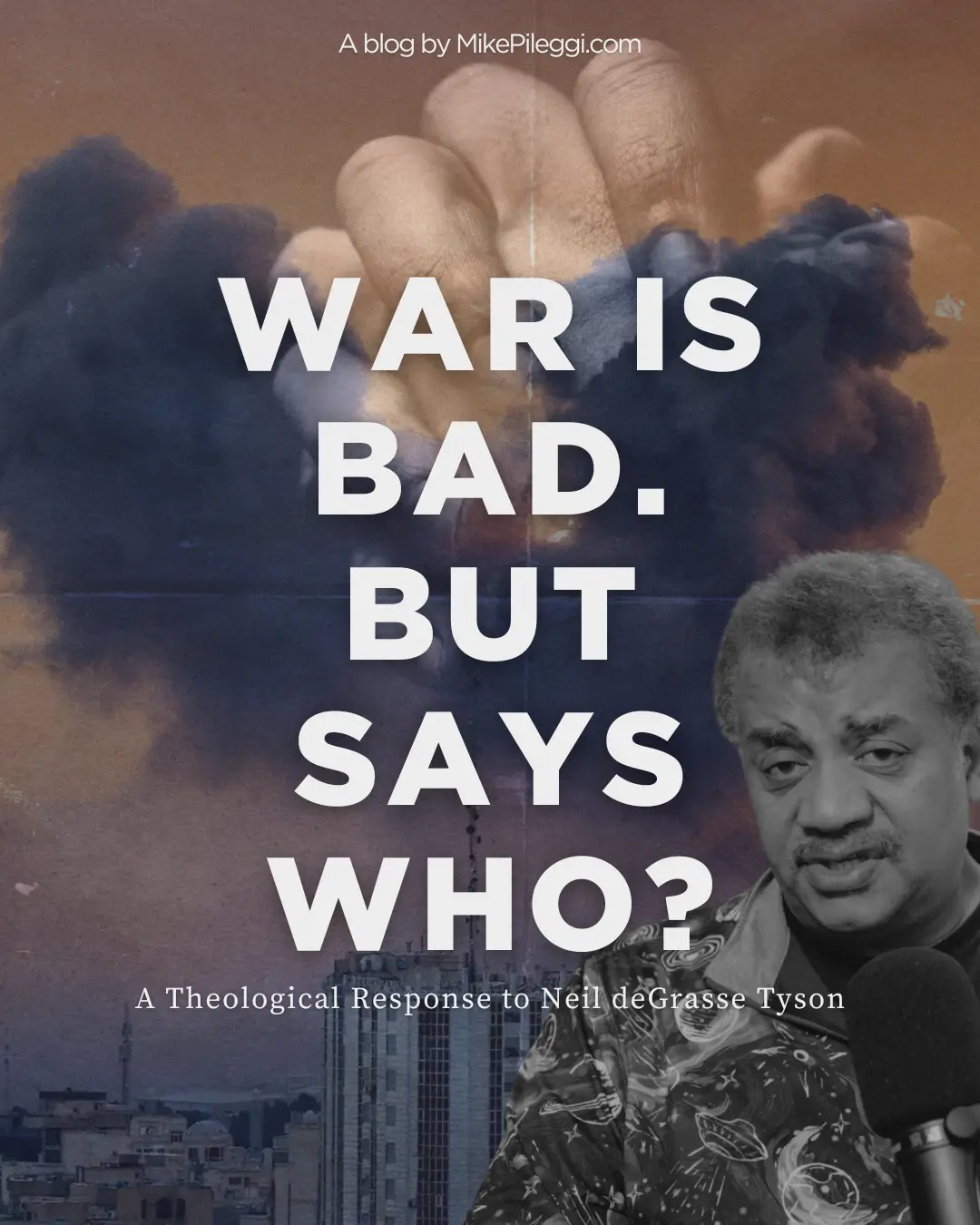 Tyson argues that war is bad. He traces the escalation of weaponry from hand-to-hand combat to nuclear arsenals, describes the horror of mutually assured destruction, and concludes with something like an appeal for coexistence. Along the way, he gestures at the idea that a sufficiently terrifying shared external threat might be the only thing capable of uniting humanity.
I agree with him that war is bad. The problem is that he never asks the prior question: bad according to whom? On what basis? By what standard?
This is not a pedantic complaint, rather this is the central question of the entire issue. If there is no moral lawgiver, if morality is simply the product of evolutionary adaptation or cultural convention, then “war is bad” is not a moral claim at all; this claim is a preference, a feeling. Perhaps a widely shared feeling, but a feeling nonetheless. And widely shared feelings do not constitute an objective moral standard. They constitute a consensus, which is not the same thing, and which can shift.
Tyson says war is bad. He is right. But he has not told us why it is bad, and the distinction matters tremendously.
Borrowed Capital
What becomes clear in watching this video is that Tyson is reasoning morally in ways that his stated worldview cannot support. His secular, naturalistic framework does not generate the moral premises he needs. It borrows them.
The concept that human beings have inherent dignity, that their suffering matters, that justice is real and not merely constructed, that the strong have obligations to the weak rather than simply the power to dominate them: these are not conclusions that emerge from a purely materialist account of the universe. They make sense within a framework where human beings are image-bearers of a personal God, where morality is grounded in the character of that God, and where there is a transcendent standard by which human actions can be meaningfully evaluated.
Tyson’s moral assumptions, and I think they are genuine ones, are drawing on that framework without acknowledging it. He is spending capital he did not earn and is not sure he has.
He even acknowledges, at one point in the video, that sometimes fighting is necessary when a power overexerts itself to control or dominate others. He understands, implicitly, that there is such a thing as just defense, that some things are worth protecting, that honor exists. But he cannot account for any of that within a worldview where right is ultimately a matter of strength and survival. He has the presuppositions of a man formed by a civilization that took seriously the idea that human beings are made in God’s image. He just has not followed those presuppositions back to their source.
 Science, Religion, and the Dichotomy He Creates
 Science, Religion, and the Dichotomy He Creates
At a certain point in the video, Tyson shifts. He cannot quite explain why war happens at its core, so he turns to religion. He frames science and religion as competing authorities, suggesting that religious certainty is the source of great violence, and implies that a more scientific temperament would produce a more peaceful world.
There is something worth engaging here, and I want to engage it fairly.
He is partially correct. People have gone to war in the name of religion. Some religious systems, including Islam in significant portions of its founding texts, do explicitly envision expansion through conflict. Surah 5 and Surah 9 of the Quran make this plain enough. Wars have also been fought under the banner of Christianity, and the history of the church contains catastrophic failures that no serious Christian should excuse or minimize.
But the question is whether this critique applies equally and fairly to Christianity itself, and whether it actually demonstrates what Tyson thinks it demonstrates. The answer to both is no.
The truth is that at the core of Christianity, there is no mandate for violent expansion. Christians are commissioned in Acts 1:8 to be witnesses, not conquerors. When Peter drew a sword at Jesus’ arrest, Jesus told him plainly that those who live by the sword will die by it. John Chrysostom, one of the great early church fathers, wrote that the blood of the martyrs is the seed of the church, meaning that the faith spreads not through domination but through suffering endured for the sake of truth. James, in his epistle, distinguishes between true and false religion, which at least opens the possibility that Tyson is not arguing against Christianity but against its counterfeits.
There is also a larger problem with Tyson’s framing. He implies that the alternative to religious certainty is peace. But the 20th century’s most catastrophic violence was not produced by religious states. It was produced by explicitly atheistic ones. Stalin and Mao were not fighting for God. They were fighting for systems of thought that replaced God with the state and the party, and together they are responsible for the deaths of hundreds of millions of people. If religion is implicated in violence, so is irreligion. The question is not religion versus science. The question is which account of human beings and human life is actually true, and which account can produce the moral framework that makes coexistence not merely a preference but an obligation.
The Scientist’s Own Belief System
What is perhaps most interesting about this video is that Tyson does not seem to recognize that he himself operates from a worldview, a set of foundational beliefs that are not themselves scientifically verifiable.
He appears to believe that faith is the problem, that faith is blind, that faith is opposed to evidence. But faith, as it is described in Hebrews 11, is not irrationality. It is certainty based on the evidence provided by a reliable source. At its root, faith is trust. And trust is something no one arrives at through purely empirical means.
Consider a simple example. Tyson cannot prove, using the scientific method, that his children love him. He cannot run a controlled experiment that produces a falsifiable hypothesis about the love of another person and reach a verifiable conclusion. He has to depend on other means of knowing, means that are not reducible to data and observation. He trusts! He believes! He has, in other words, faith.
His worldview is naturalistic, but he does not consistently apply that naturalism to every dimension of his life, because he cannot. A purely naturalistic account of human experience leaves out too much of what is most real. And the vigor he brings to his own certainties, the confidence with which he dismisses the metaphysical, is not itself derived from the scientific method. These are philosophical commitments he brings to the method.
 Evidence He Dismisses Too Quickly
 Evidence He Dismisses Too Quickly
When Tyson briefly addresses the question of whether the universe’s existence might point beyond itself, he dismisses the suggestion quickly. He appears to believe that the equations of physics are sufficient to close the question.
But the cosmological, teleological, and moral arguments for God’s existence have not dissolved simply because science has made remarkable progress. The universe coming into existence out of nothing remains a philosophical and mathematical impossibility if we do not posit a cause that is itself uncaused. Nothing, by definition, produces nothing. The fine-tuning of the universe is so precisely calibrated for the existence of life that dismissing it requires more confidence than the evidence warrants. The second law of thermodynamics predicts that energy dissipates over time, and yet the universe continues to expand. Cells are irreducibly complex mechanisms, remove a single component and life ceases. Proteins, amino acids, the entire biochemical architecture of living things press back against the idea that their arrangement was simply the result of random processes given enough time.
None of this is decisive in isolation. But the cumulative weight of these arguments deserves better than a quick dismissal. The very fact that we can formulate something like E=MC² demonstrates that there is a natural law. The question is who set it into motion, because laws do not write themselves.
 Why War Is Actually Horrible
 Why War Is Actually Horrible
At the end of the video, Tyson describes his feelings about war. He says it is terrible. He says he wants humanity to find common cause and build something beautiful together. I believe him. I think he means it.
But he has not told us why war is horrible, only that it is. He has not told us why coexistence is good, only that he wants it. He has not told us why beauty is worth preserving, or what beauty actually is.
The Christian worldview answers these questions. War is terrible because human beings are made in the image of God, and their lives are intrinsically valuable. To destroy a human life is not simply to eliminate a biological unit or reduce a population figure. It is to destroy a bearer of God’s image, a creature in whom God has invested dignity and purpose and eternal significance. This is why war carries moral weight, not just emotional weight.
God does not delight in war. The same God who called Israel to judgment against Canaan, after four centuries of child sacrifice and persistent rebellion, is the God who wept over Jerusalem, who commanded his people to seek peace and pursue it, who sent his Son not to conquer by force but to redeem through suffering. These realities do not contradict each other. They cohere within a God who is both perfectly just and perfectly merciful.
Tyson says, at one point, that the more abstract the argument becomes, the harder it is to defend objectively. He is correct. Which is exactly why his own position cannot bear the weight he places on it. He is relying on moral intuitions formed in a society built, however imperfectly, by people who took God seriously. Their motivations were not merely civic or scientific. They were for God’s glory. That is the difference, and it is not a small one.
A Closing Thought
I do not write this to attack Neil deGrasse Tyson. The questions he is raising about war, human nature, whether we can live together and what we owe each other, are real questions. They are among the most important questions. And they deserve better answers than his worldview can provide. There is also an appropriate response from the Christian Worldview that I answer in this post.
There is a certain irony in the video. Tyson calls for something genuinely beautiful: coexistence, shared purpose, peace. These are things the Christian faith has been calling people toward for two thousand years, not because science demands it, and not because evolution produced those instincts, but because the God who made us is himself the source of beauty, the ground of peace, and the only one who can tell us, with genuine authority, that war is bad and life is good and that both of those things are true not merely because we feel them but because they are real.
He is looking for something the worldview he holds cannot give him. That is worth noticing, and it is worth saying so out loud.