Why “I Can’t See How That’s Just” Doesn’t Prove God Unjust
Recently I sat and listened to another atheist raise objections against Scripture, and the strange thing about it was not that the objections were new. The strange thing was how familiar they were. Different passages, different emotional pressure points, different rhetorical packaging, but underneath all of it, the same basic move. Moral revulsion first. Then a refusal to consider whether there might be more to the passage than his framing allowed.
That order matters. You cannot read a text honestly if your verdict has already been reached before you sit down with it. And once I noticed the pattern, I started to notice it everywhere.
There are difficult passages in Scripture. I am not going to pretend otherwise, and I think Christians do themselves no favors by pretending either. There are places where God judges with severity. There are places where ancient warfare is described in language that modern readers find jarring. There are civil laws given to Israel that do not slot neatly into contemporary Western moral categories. There are moments when the holiness of God confronts our age with categories we are not used to carrying around. A faithful response does not mean flattening those difficulties or speaking about them with detachment. It means refusing to let an emotionally loaded paraphrase replace the actual argument.
As I listened, I eventually realized that many of these objections were being collected and distributed through a website that catalogs supposedly irreconcilable Bible passages. The method is consistent, almost mechanical. Pick a passage. Attach the worst possible moral summary to it. Strip out the context. Then conclude that the God of Scripture must be immoral. The website is not saying, “Here is a difficult passage, let us examine it together carefully.” It is saying, “Here is the verdict, and the passage is the evidence.”
This is where the problem becomes more than a matter of interpretation. It becomes epistemology.
The atheist is not simply saying, “I find this passage difficult.” That would be understandable, even respectable. Plenty of believers have wrestled with hard passages in good faith. The atheist is usually saying something stronger: “I do not see a morally sufficient reason for God to command or permit this, therefore there is no morally sufficient reason.” That is a much larger claim. And it is almost always assumed, not argued.
What is a “no-see-um” argument?
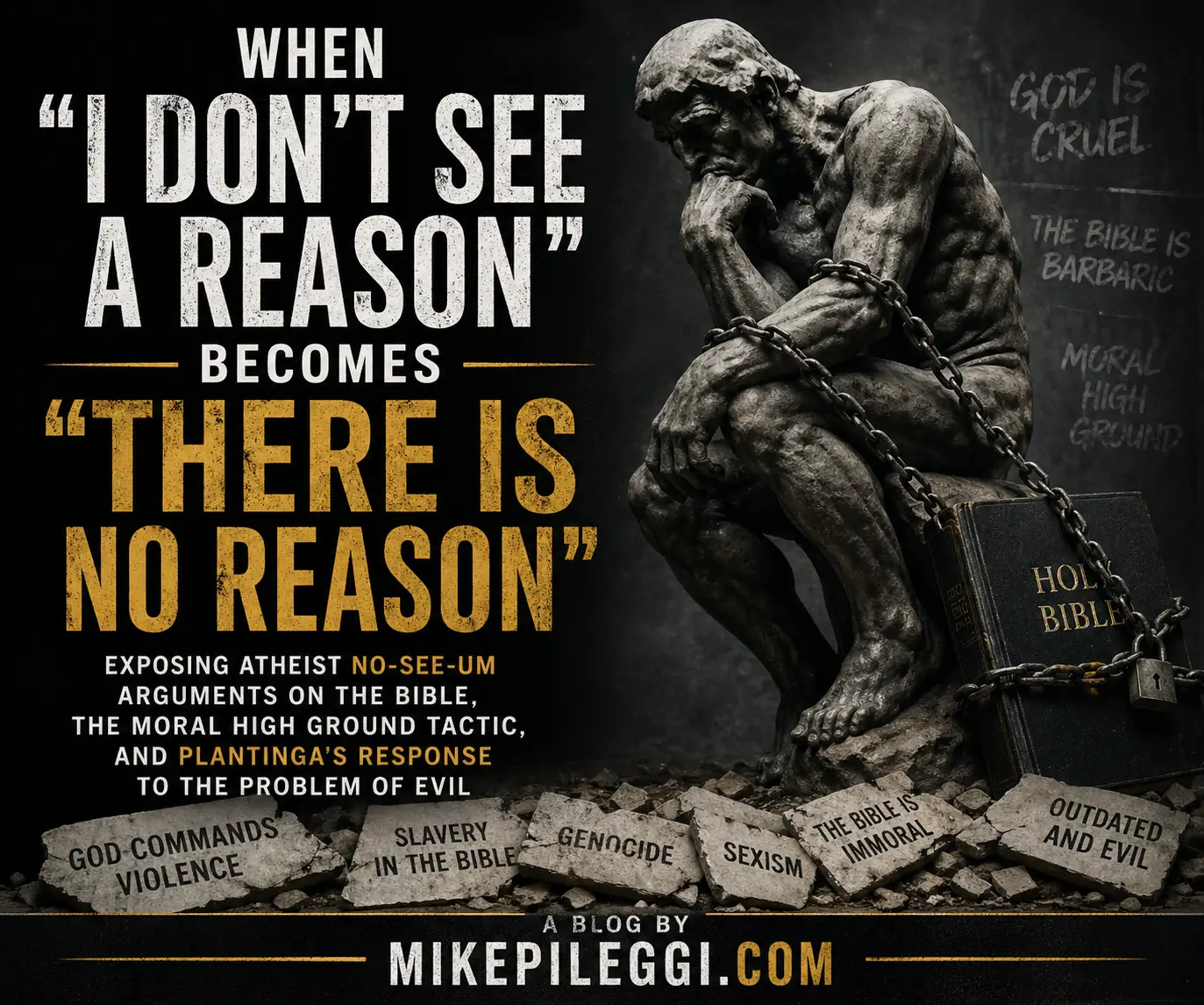
In philosophy, this kind of reasoning has a name. It is sometimes called a “no-see-um” argument, and the form is simple: I do not see X, therefore X is not there. Sometimes that form of reasoning is perfectly reasonable. If I walk into a small room, look around, and say, “I do not see an elephant in here, so there probably is not one,” that holds up. An elephant is the kind of thing I should expect to see if it were present. But if I say, “I do not see bacteria on this table, therefore there are no bacteria here,” my conclusion does not follow. Bacteria are not the sort of thing I should expect to see with the naked eye.
That is exactly the issue with most atheist objections to difficult biblical passages. The atheist looks at an ancient text dealing with covenant law, divine judgment, warfare, holiness, sin, and the long arc of redemptive history, and he says, “I do not see a morally sufficient reason God would do this, therefore God has none.” Why should that follow? Why should a finite creature, standing centuries after the fact, with limited knowledge of the historical moment, limited knowledge of God’s covenant purposes, limited knowledge of future consequences, and limited moral perception, assume that if God had a morally sufficient reason for what He did, that reason would be obvious from where the creature happens to be standing?
That assumption needs to be argued for. It cannot just be smuggled into the conversation in moral packaging.
This is why these arguments often feel impossible to answer. Not because there are no answers. Because no answer is being allowed to count. Point to context, and the context is dismissed as not helping. Point to genre, and that is called special pleading. Point to the difference between Israel under the Mosaic covenant and the New Covenant church, and that is called dodging. Point to due process within Israel’s legal system, and the law is still called barbaric. Point to the possibility that God may have morally sufficient reasons we cannot see, and that is called blind faith.
At that point, the conversation is no longer about one text. It is about whether the atheist is willing to consider any explanation that does not end with the conclusion he already prefers.
Is the argument actually about the text?
I want to be careful here, because not every atheist is consciously dishonest, and not every objection is insincere. Some people are genuinely troubled. Some people have been wounded by bad teaching, shallow answers, or hypocritical Christians. Those things should make us patient. But there is a kind of argument that presents itself as moral clarity while refusing to engage the strongest version of the Christian response. It is not really after truth, it is after confirmation.
Part of the strategy is the moral high ground. The atheist positions himself as the compassionate observer who can see what the Christian is too indoctrinated to admit. But moral disgust is not the same thing as moral reasoning. A person can be emotionally disturbed by a passage and still misunderstand it. A person can find a command severe and still fail to show that it is unjust. A person can dislike the God of Scripture and still not have disproven Him.
This is really a new form of an old objection. The classic Epicurean problem says, in essence, that if God is willing to prevent evil but not able, He is not omnipotent; if He is able but not willing, He is not good; and if He is both willing and able, evil should not exist. The modern atheist takes that same structure and applies it down at the level of specific passages: “If God were good, He would not have commanded this. If God commanded this, He is not good.” That argument only works if the atheist can show that there is no possible morally sufficient reason for God to act as He did.
While I was in seminary I learned about Alvin Plantinga’s work on how to answer this/
What did Plantinga actually do?
Plantinga did not need to explain every instance of evil in order to answer the logical problem of evil. He did not need to give us a reason for every tragedy, every act of suffering, every painful event in human history. His point was more modest, and devastating to the atheist’s argument. If it is even possible that God has a morally sufficient reason for permitting evil, then the atheist has not shown a logical contradiction between the existence of God and the existence of evil.
That distinction is everything.
The atheist often wants more than he can prove. He wants to move from “I do not know why God would permit this” to “God could not have a morally sufficient reason.” Those are not the same claim. The first is a statement about the limits of human understanding. The second is a sweeping claim about the nature of reality itself.
Plantinga exposed the overreach. He showed that the logical problem of evil collapses if there is even a possible scenario in which God and evil can coexist without contradiction. The Christian does not have to know every reason God has in order to demonstrate that the atheist has not proven God unjust. The burden of proof rests on the one making the larger claim.
That same principle holds when the atheist weaponizes difficult biblical passages. The Christian does not need to pretend that every passage is emotionally easy on modern instincts. The Christian does not even need to know every reason God had for every command in redemptive history. The atheist needs to do more than say, “I do not see a good reason.” He has to show that God could not have one.
That is a much harder task than it usually gets treated as.
What about the actual passages?
Take the objection in Joshua 11 about God commanding Israel to hamstring horses. At first glance, the objection is emotionally powerful. Why something so severe? Why not just take the horses? Why not let them go? Why disable them rather than kill them outright? Those are real questions. But often the atheist presses them as if the emotional force of the questions is itself the proof.
The text is not about random cruelty to animals. The horses in question were part of an enemy chariot force. In the ancient world, horses and chariots were the heavy weaponry of military dominance. Israel was being commanded to dismantle the enemy’s war machinery and not preserve that power for itself. This matters because Israel was repeatedly warned not to trust in horses and chariots like the surrounding nations. The command is severe, no question. But severity is not the same thing as pointless cruelty.
Does that resolve every emotional reaction? No. But it does show that the atheist’s summary is too simple. The passage is not “God enjoys watching animals suffer.” The passage concerns warfare, judgment, military disarmament, and Israel’s covenantal dependence on the Lord rather than the war machinery of pagan kingdoms.
The atheist may still say, “I do not like that.” Fair enough. But “I do not like that” is not the same as “therefore God is immoral.”
Or take Deuteronomy 22 and the case of a husband accusing his new wife of sexual deception. The atheist may summarize it as, “The Bible says to stone women for not being virgins.” That is not what the text actually does. The passage describes a specific legal situation involving a husband bringing a public accusation, the case being adjudicated before the elders, severe punishment for the husband if his accusation is found to be a lie, and all of it happening within Deuteronomy’s broader legal framework requiring two or three witnesses for capital cases. The passage is still severe. It still belongs to a covenantal world that is not ours. But the atheist’s summary is not neutral. It is a morally loaded reduction designed to make the reader recoil before reading.
The question is not whether the passage feels easy. The question is whether the atheist has fairly represented what the passage is doing.
He often has not.
This is why Christians need to recognize the pattern. The atheist is frequently not arguing from the text so much as from a rhetorical reconstruction of the text. Strip out the covenant setting. Strip out the legal context. Strip out the canonical balance. Strip out the redemptive-historical location. Then ask the Christian to defend the caricature. When the Christian declines to defend the caricature and explains the passage instead, the atheist treats the explanation as evasion.
Careful interpretation is not evasion. Context is not a trick. Theology is not a dodge. Reading Scripture as Scripture, with attention to covenant, canon, genre, and redemptive history, is not special pleading. It is basic honesty.
Whose moral standard is being borrowed?
The deeper issue, and this is the one that often goes unnoticed in the heat of the conversation, is that the atheist is trying to judge God while borrowing the moral capital of a world that only makes sense if God exists. He wants objective moral outrage, but he also wants a worldview in which morality is not grounded in the holy character of God. He wants to condemn ancient Israel by a moral standard that hovers above culture, but he often cannot account for that standard within his own system. He wants to say, “This is evil,” not merely, “This offends my modern preferences.” The moment he says it, he has stepped into the territory of objective moral law, and objective moral law raises the question of a moral Lawgiver.
That does not automatically resolve every difficult passage. But it does expose the instability of the position. He is standing on borrowed ground while accusing the Bible of moral failure.
This is why Christians should not let these conversations get reduced to emotional theater. We can acknowledge the weight of difficult passages without conceding the atheist’s conclusion. We can say, “I understand why this troubles you,” and also, “Your discomfort does not prove injustice.” We can say, “This text is severe,” and also, “You have not shown that it is immoral.” We can say, “I do not know every reason God had,” and also, “Your inability to see His reasons does not prove He has none.”
That last one is the sentence I want to sit on, because it carries more weight than people often realize.
What is the difference between humility and unbelief?
There is a great difference between the two. Humility says, “This is difficult, and I want to understand.” Unbelief says, “This is difficult, therefore God is guilty.” Humility brings questions to the text. Unbelief brings a verdict to the text. Humility is willing to be corrected by God. Unbelief demands that God be corrected by us.
I do not say any of this to mock people who genuinely struggle with hard passages. Christians should be patient with honest questions. We should not give shallow answers, and we should not pretend the tensions are not there. But we also should not be intimidated by a form of argument that has already decided God is wrong before the conversation begins.
At some point it is fair to ask the atheist directly: what would count as an answer for you? If no answer would count unless it makes the passage emotionally comfortable to modern sensibilities, then the standard is not reason, it is autonomy. If no explanation is allowed unless it removes the severity of divine judgment, then the issue is not really Joshua, or Deuteronomy, or any other difficult text. The issue is whether God is permitted to be holy in ways that offend our age.
That is where the Christian must stand firm.
Where does this leave us?
The God of Scripture is not on trial before modern man. We are the ones who stand before Him. That does not mean we cannot ask questions. It does not mean we cannot wrestle. It does not mean we cannot search for understanding. It does mean that our moral instincts, shaped as they are by our culture, our finitude, our sin, and our limited knowledge, are not the final court of appeal.
If Christianity is true, we should expect some of what God says and does to exceed our immediate comprehension. We should expect divine holiness to feel strange to sinners. We should expect judgment to trouble a world that has minimized sin. We should expect the living God to be more severe than our sentimental age wants Him to be, and more merciful than our guilty consciences dare hope.
The cross proves both at once. At the cross, God shows us that sin is far worse than we thought and mercy is far greater than we imagined. He does not solve evil by pretending it is small. He does not redeem sinners by lowering the standard of holiness. He judges sin fully and saves sinners freely through the death and resurrection of Christ.
So when the atheist brings difficult passages, we should not panic. Read carefully. Answer honestly. Distinguish discomfort from contradiction. Expose the no-see-um argument when it appears. The atheist may not see God’s reasons. We may not see all of them either. But our inability to see the whole counsel of God from our limited vantage point is not evidence that God has failed. It is a reminder that we are creatures.
If the atheist refuses to see that distinction, then the problem is no longer that Christianity lacks an answer. The problem is that he has decided beforehand that no answer will be allowed to count.
That is not moral courage.
That is not intellectual honesty.
That is unbelief dressed in the language of justice.