The Quiet Crisis: What the Numbers Say About Nominal Christianity in America
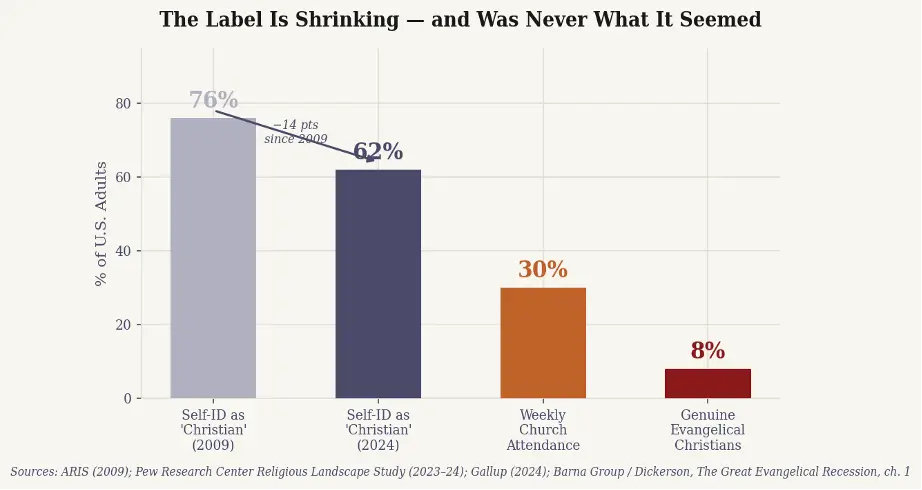
Seventy-six percent of Americans called themselves Christian as recently as 2009. For a long time, that number served as reassurance, or even evidence that the United States remained, in some meaningful sense, a Christian nation. Leaders cited it. Ministries built fundraising appeals around it. Politicians courted it.
The number was real. The problem is what it was actually measuring.
By 2024, that figure had dropped to 62%, according to the Pew Research Center’s most recent Religious Landscape Study. Fourteen points in fifteen years. That is not a rounding error by any stretch, that is generational drift. And yet the more significant problem is not the shrinkage of the label. It is what was always hiding behind the label, even when it was larger. Self-identification is not the same as conviction. Claiming the name is not the same as holding the faith.
This is what John S. Dickerson called The Great Evangelical Recession, and it is worth taking seriously because the church cannot fix a problem it refuses to name.
 The Gap Between the Label and the Reality
When Dickerson compiled the research for his 2013 book, four independent researchers, using different methodologies, had each arrived at roughly the same conclusion. Christian Smith, a sociologist at the University of Notre Dame, estimated that genuine evangelical Christians account for about 7% of the American population. David T. Olson, working from actual attendance data at more than 200,000 U.S. churches, came to 8.9%. The Barna Group landed around 7%. Christine Wicker, a religion journalist who examined Southern Baptist internal data and cross-examined the National Association of Evangelicals’ claimed 30 million figure, also confirmed roughly 7%.1
That gap has not closed. Pew’s 2023–24 Religious Landscape Study puts Christian self-identification at 62% of U.S. adults.2 Meanwhile, Gallup found in 2024 that more than half of Americans — 56% — say they seldom or never attend religious services, with only about 30% attending weekly or nearly weekly. 3
The label is smaller than it used to be, and it was never what it seemed. About 22 million people, Dickerson observes, qualify as genuine evangelicals by any consistent measure. Roughly the population of New York State.
 The Worldview Collapse
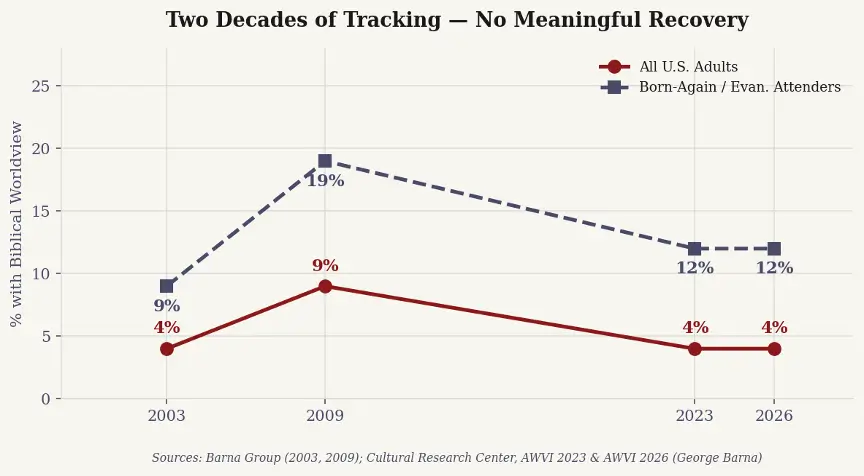
The Barna Group has been tracking “biblical worldview” — a basic alignment between a person’s actual beliefs and the foundational claims of historic Christianity — for more than two decades. The results have been remarkably consistent, and consistently sobering.
In 2003, Barna found that roughly 4% of American adults held a biblical worldview. By 2009, that figure had moved to about 9% among adults generally.4 The Cultural Research Center at Arizona Christian University, continuing this research, found in 2026 that only 4% of American adults qualify as what they call “Integrated Disciples” — people whose beliefs and behaviors are coherently shaped by a biblical framework.5
Among adults aged 16–23, the number Barna found was less than half of one percent.6
The consistent direction of two decades of data is not in doubt. The problem does not disappear when researchers narrow the sample to church attenders or people who describe themselves as born again. The crisis is structural, and it is not improving.
 The Real Religion in Many Pews
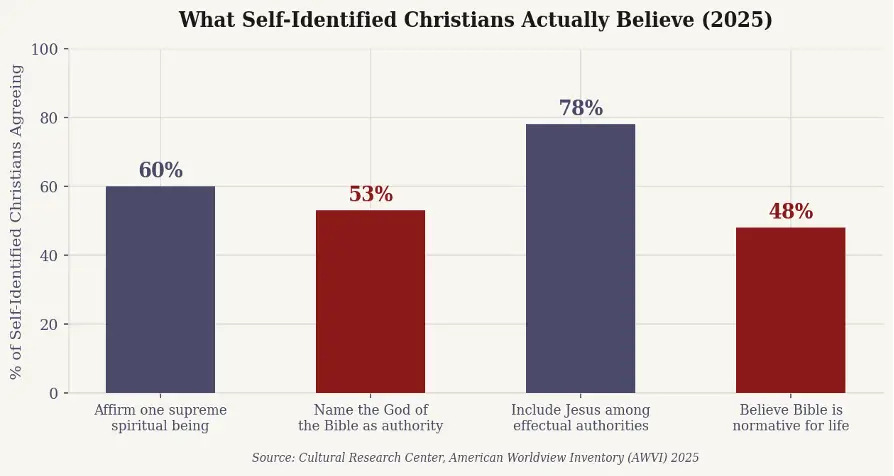
The Cultural Research Center’s 2025 American Worldview Inventory puts hard numbers to what many pastors have long suspected. Among self-identified Christians, only 60% affirmed that there is one supreme spiritual being who created and rules everything. Only 53% named the God of the Bible as an existing and influential authority. 7 Twenty-two percent did not include Jesus Christ among living, effectual spiritual authorities.
Christian Smith, in his landmark study Soul Searching (2005), gave this drift a name: Moralistic Therapeutic Deism. In this functional creed, God exists but stays in the background unless someone needs him. The purpose of life is to be happy and feel good about yourself. Good people go to heaven when they die. The Bible is not necessarily authoritative for daily decisions. Personal spiritual feelings matter more than doctrine.
The most damning detail in Smith’s research was not that teenagers held these beliefs. It was that evangelical teenagers held them at roughly the same rate as their unchurched peers. Dickerson, drawing on these findings, notes: “Evangelical teens are no less likely than unbelievers to believe that all good people go to heaven.”
A church can remain crowded while its theology becomes thin. The labels stay in place. The music continues. The budgets survive. And the actual content of what people believe quietly drifts from the faith once for all delivered to the saints.
 What the Behavior Data Confirms
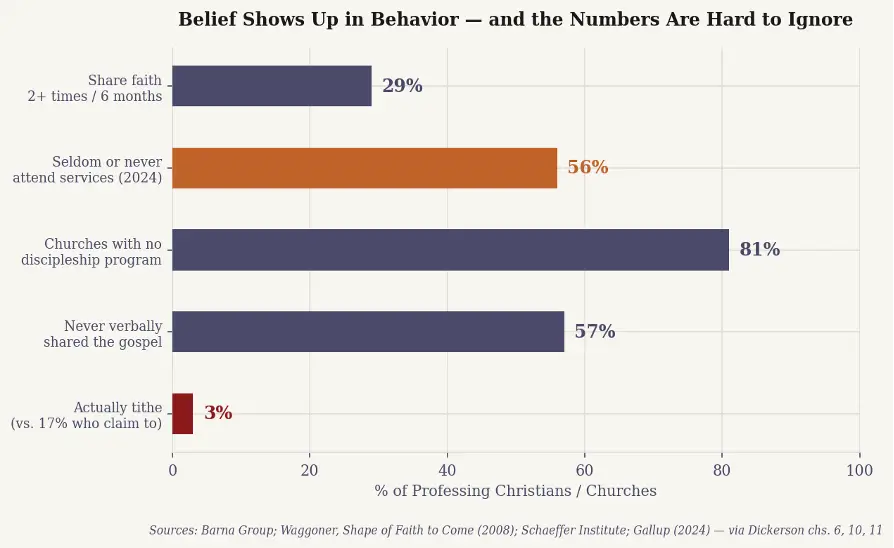
Belief does not stay abstract. Belief shows up in how people live, and the behavioral data on American Christianity is equally difficult to brush aside.
Barna’s research found that while roughly 17% of American churchgoers claim to tithe, only about 3% actually do.8 Brad Waggoner’s The Shape of Faith to Come, a study of 2,500 churchgoers, found that 57% of Protestant churchgoers had never verbally shared the gospel with another person.9 A survey of pastors by the Schaeffer Institute found that 81% of churches had no discipleship program in place.10
And in 2024, Gallup found that 56% of Americans say they seldom or never attend religious services.11 That figure includes people who still call themselves Christians. Whatever the label is carrying, it is not carrying consistent engagement with the body of Christ.
These numbers describe something more specific than “low engagement.” They describe a church that has largely stopped asking its members to be disciples, and largely stopped noticing that most of them aren’t disciples.
 The Next Generation Tells the Truth
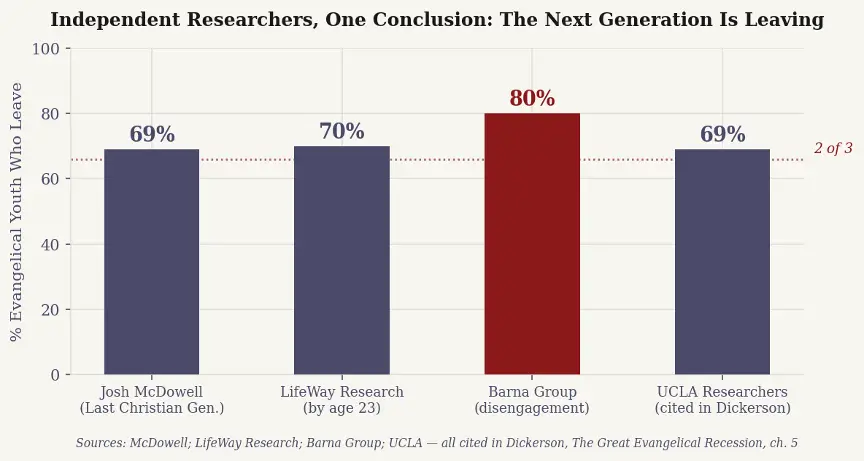
If there is a single place where the consequences of nominal Christianity become undeniable, it is in the generational data. Josh McDowell’s research found that 69% of evangelical youth leave the church. LifeWay found 70% had left by age 23. Barna’s broader figures on disengagement run as high as 80%.12
Only about 35% ever return, according to LifeWay.13
This is not primarily a cultural problem, though culture is certainly pressing. This is a discipleship problem. Thin theology does not transmit. A faith built more on comfort than conviction, more on familiarity than formation, more on emotional resonance than biblical truth is not the kind of faith that survives serious challenge, serious loss, or even simply the ordinary drift of early adulthood. Dickerson frames it plainly: if evangelical young adults have not embraced a biblical worldview, it will be difficult for them to pass one on to the next generation.14
Princeton researcher Kenda Creasy Dean put it this way: “The problem beneath the loss of our youth has everything to do with our fumbling of basic discipleship among our adults.”15
 The Solution Is Not Complicated — It Is Just Hard
Dickerson’s diagnosis leads to a remedy that is neither novel nor complex. It is the one Jesus gave. “More than anything else, 21st-Century Evangelicalism depends on making disciples who then make disciples (2 Timothy 2:2).”16
He is not calling for a new program. He is not proposing a rebrand. He is calling the church back to the primary work it was commissioned to do: making disciples, person to person, generation to generation, with the patience and intentionality that genuine formation requires.
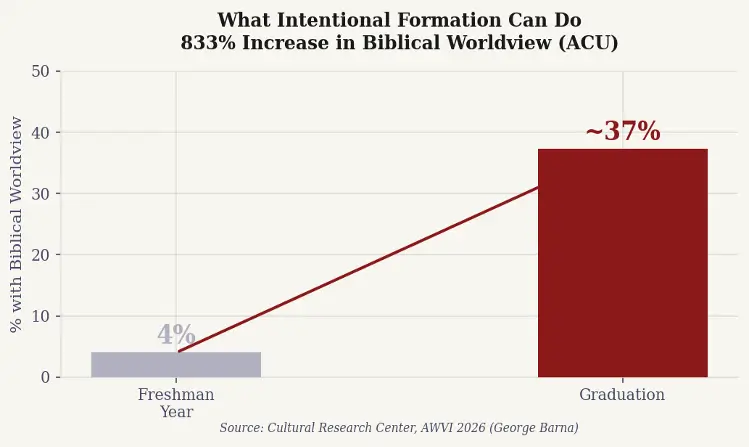
There is evidence this can work. The Cultural Research Center’s 2026 data tracked Arizona Christian University’s students from freshman year to graduation and found an 833% increase in biblical worldview incidence over that period.17 That is not a magic number, and one institution’s results cannot carry the weight of a whole movement. But it does demonstrate that formation works when it is intentional, sustained, and structured around actual theological content rather than spiritual atmosphere.
 What This Asks of Pastors and Church Leaders
The pastoral response to nominal Christianity is not to panic, and it is not to ignore the data and keep counting heads. It is something more difficult and more durable than either of those options.
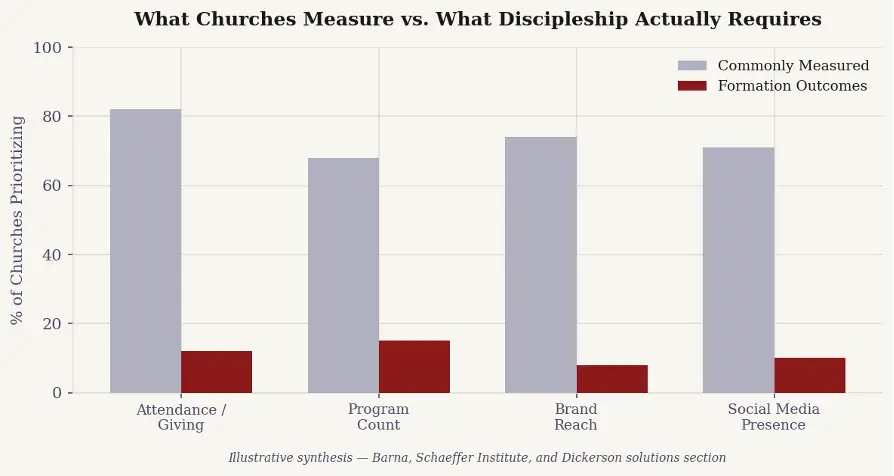
It means telling the truth about church health. Attendance figures and giving numbers are not measures of discipleship, and leaders who treat them as if they are will keep producing the problem they are trying to solve. It means measuring maturity, not just metrics. It means rebuilding doctrine and worldview formation in the ordinary life of the congregation, not as a special program but as the texture of what the church actually does week after week. It means investing heavily in younger generations before a therapeutic faith calcifies into something that cannot be moved. And it means recovering relational disciple-making as the center of ministry, not as one offering among many.
Dickerson ends his book with a challenge that has not lost its force: “Like Mickey, you and I now stand in a moment of decision. Will we act on what we have learned, or will we settle comfortably back into the American church as we have always done it?” 18
The quiet crisis is real. The numbers are not going away. The question is whether the church will choose the harder and more faithful path: making disciples who make disciples, telling the truth about what health actually looks like, and refusing to be comforted by labels that are doing work the faith is not.
Sources
1. John S. Dickerson, The Great Evangelical Recession (Baker Books, 2013), ch. 1 (“Inflated”). Figures from Christian Smith (Notre Dame), David T. Olson (The American Church in Crisis, Zondervan, 2008), Barna Group (Futurecast, 2011), and Christine Wicker (The Fall of the Evangelical Nation, Harper, 2008).↩
2. Pew Research Center, 2023–24 Religious Landscape Study (released February 2025). Available at pewresearch.org. ↩
3. Gallup, “More Than Half of Americans Rarely Go to Church,” March 2024. Available at gallup.com. ↩
4. Barna Group, “A Biblical Worldview Has a Radical Effect on a Person’s Life” (2003); Barna Group, “Changes in Worldview Among Christians over the Past 13 Years” (2009). ↩
5. Cultural Research Center, Arizona Christian University, AWVI 2026 (George Barna, principal researcher). ↩
6. Barna Group survey cited in Dickerson, The Great Evangelical Recession, ch. 5.↩
7. Cultural Research Center, American Worldview Inventory (AWVI) 2025.↩
8. Barna Group data cited in Dickerson, The Great Evangelical Recession, ch. 10.↩
9. Brad Waggoner, The Shape of Faith to Come (B&H Books, 2008), cited in Dickerson, ch. 6.↩
10. Schaeffer Institute survey of pastors, cited in Dickerson, The Great Evangelical Recession, ch. 11. ↩
11. Gallup, “More Than Half of Americans Rarely Go to Church,” March 2024.↩
12. Josh McDowell, The Last Christian Generation (2006); LifeWay Research; Barna Group; UCLA researchers — all cited in Dickerson, ch. 5.↩
13. LifeWay Research, cited in Nominal Christianity in America research presentation (2025).↩
14. Dickerson, The Great Evangelical Recession, ch. 5. ↩
15. Kenda Creasy Dean, cited in The Quiet Crisis research presentation (2025).↩
16. Dickerson, The Great Evangelical Recession, conclusion (p. 46).↩
17. Cultural Research Center, AWVI 2026.↩
18. Dickerson, The Great Evangelical Recession, conclusion (p. 46).↩