The Bible and Slavery
Facing the difficult passages and the moral questions they raise
By Mike Pileggi
If God is good, why does the Bible contain laws permitting people to own other people? Why do the apostles tell slaves to obey their masters? And why should someone trust a book that Christians have used to defend slavery?
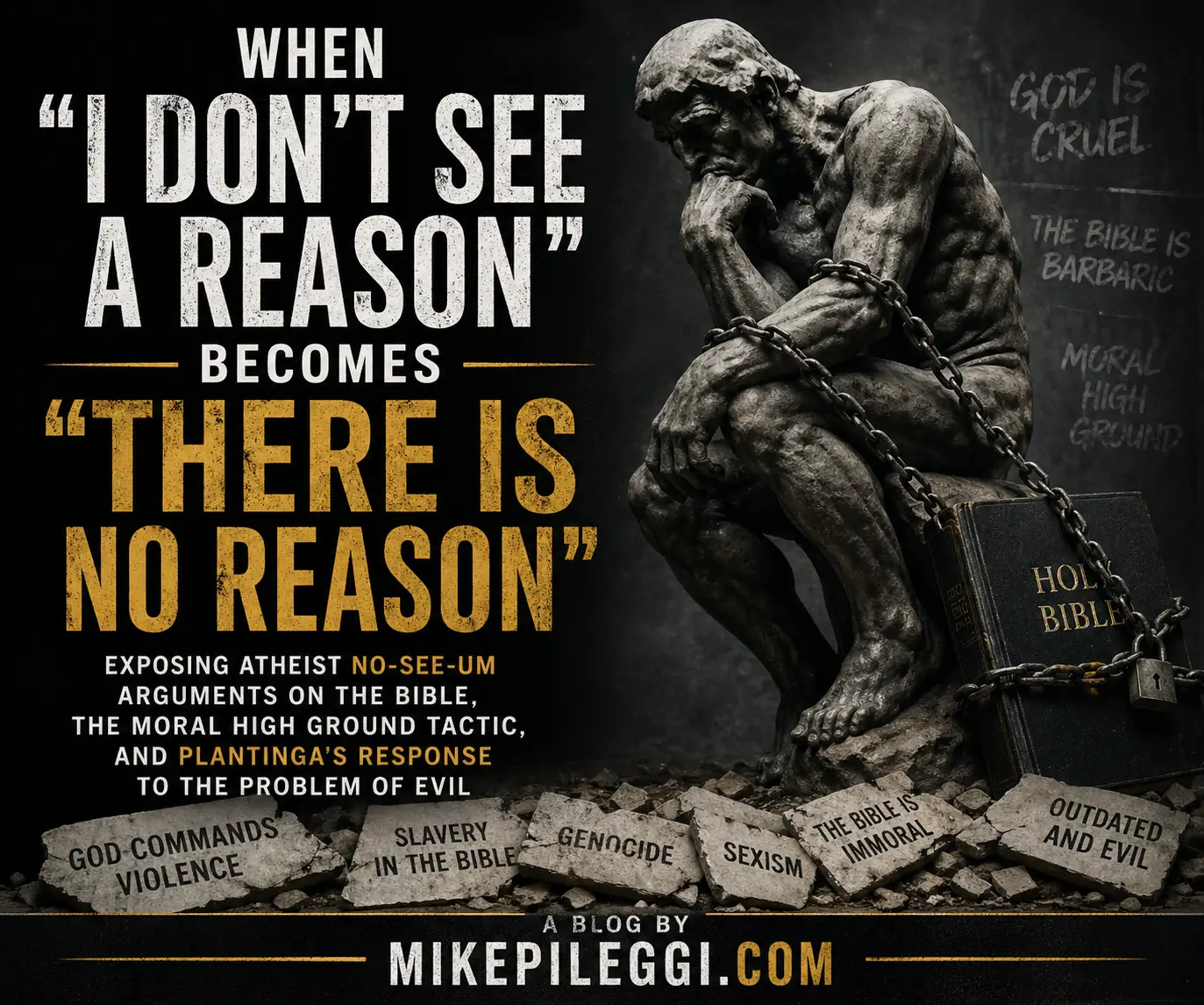
Over the last few months, I have spent a significant amount of time listening to atheists and ex-Christian deconstructionists challenge the credibility of the Bible. I can’t help but notice that slavery comes up repeatedly. More often than not, at least in the exchanges I have been watching, the question comes from someone who seems determined to embarrass a Christian. At the same time, especially in debates, I have seen how Christians struggle to reconcile these passages with God’s character.
As a pastor and Bible teacher, I also think about the Christian watching these conversations who has never studied the passages being quoted. A confident accusation can leave someone wondering whether faithfulness to Scripture requires defending cruelty. In fact, even I have left with more questions than answers from some of these debates.
However, I believe we can face these passages honestly and still trust the goodness of God. Getting there requires more than repeating a familiar apologetics response. We have to follow the Bible’s story far enough to see what God does about the evil He permits, and what He reveals about Himself in Jesus Christ.
The Passages We Have to Face
I think the greatest problem lies in what Christians say when tackling passages that regulate slavery. Christians sometimes say that slavery in the Bible was essentially employment or a temporary arrangement for paying off debt. The truth is more complicated than that. Some biblical laws do concern poverty and limited service, but that’s not the full scope.
For example, Exodus 21:2–6 provides release after six years for a Hebrew male slave. Yet if his master supplied a wife, the wife and children remained with the master when the man left. Moreover, the passage also condones permanent service. In fact, Verses 7–11 address a daughter sold into a household under a different set of provisions connected with marriage.
Or consider Leviticus 25:39–46, which makes a distinction between impoverished Israelites and slaves acquired from surrounding nations or resident foreign families. The latter could be held permanently and passed on to the owner’s children. Interestingly, the text uses the language of possession and inheritance. Therefore, calling those slaves employees would conceal what the passage says.
Then there is also something even darker in Exodus 21:20–21. This law requires punishment when an enslaved person dies directly under a master’s beating. Before saying that the passage protects the slave from a beating, it is important to know that the following verse prohibits vengeance if the person survives a day or two, explicitly invoking the owner’s property interest. To say this is a difficult law to defend is an understatement.
Still, the same chapter, prohibits kidnapping in verse 16 and requires release of a slave for the destruction of an enslaved person’s eye or tooth in verses 26–27. Those protections place real limits on an owner’s power, but they do not erase the coercion that the chapter also permits, nor turn the ownership language in Leviticus into something other than ownership.
Lastly, in Deuteronomy 15:12–15, we find that released Hebrew servants must receive material provisions, because the Israelites themselves had been slaves in Egypt. This is the one most Christians easily recall. God takes their welfare seriously. Yet, we still cannot extend those release provisions to everyone when Leviticus explicitly distinguishes foreign slaves.
An accurate answer has to account for both the protections and the permissions.
What do We Mean by Condone
The Christian response to these passages often distinguishes regulation from endorsement. That distinction is valid, but we need to explain what we mean.
I heard a debate between a famous atheist and a well-known apologist go terribly wrong because the Christian would not concede that condone could accurately describe what was happening in the Bible.
“Condone: to accept, allow, or overlook behavior that is considered morally wrong, illegal, or offensive without punishing or blaming it.”
If someone uses condone to mean that the Mosaic law legally permitted forms of slavery, the answer is yes. That is because Leviticus does more than report that slavery happened. The law authorizes acquisition and continued possession under the conditions described.
However, if someone means that every practice permitted in Israel’s civil law expresses God’s ultimate design for human relationships, that conclusion needs an argument. Jesus Himself gives us a reason to distinguish the two.
In Matthew 19:3–9, the Pharisees appeal to the Mosaic provision for divorce. Jesus explains that Moses permitted divorce because of human hardness of heart, then directs them back to God’s intention in creation. A provision in the law could govern a damaged situation without making that situation the pattern humanity was created to follow.
One should note that in this case, Jesus is speaking about divorce. However, this interpretive provision by Jesus is helpful to infer that the slavery laws can fit within a similar framework of God regulating damaged relationships in a fallen society. Such provisions can restrain wrongdoing and protect vulnerable people while accommodating conditions that fall short of creation’s purpose. These inferences are not fallacies of false relevancy or equivocation, because the relevance here is a law given by God that breaks God’s original design for humanity.
The Biggest Pushback to Using Matthew 19
The biggest pushback is that God prohibited idolatry; so, why not prohibit owning another person? Why give foreign slaves fewer protections against permanent enslavement? Being less than ideal is not, by itself, a sufficient defense of a practice.
Leviticus connects Israel’s distinctive release protections to God’s deliverance of Israel from Egypt and His claim upon that people. That explains the covenantal distinction the law makes. The distinction does not establish that foreigners possess less human worth, and it leaves us with a serious question about why God allowed the difference in legal treatment.
The fact is, I do not think Christians should pretend to know every reason for those permissions. God certainly had the authority to forbid slavery outright. An explanation that depends on God being unable to require more would fail on Christian terms.
At the same time, there is a difference between being unable to explain why God permitted something and demonstrating that God had no morally sufficient reason for permitting it. Our unanswered questions cannot, by themselves, establish that He is unjust. We also have to consider what God has revealed about His character and where these laws belong in His dealings with humanity.
Where These Laws Fit in the Biblical Story
The Bible begins with human beings bearing God’s image. Genesis 1:26–27 gives dignity to humanity without assigning one people a greater claim to it than another. In other words, human usefulness does not determine human worth.
We also know that very early in the creation narrative sin enters the world. The rupture described in Genesis 3 reaches into our relationships, our work, and eventually every society we build. Meaning that the exploitation of other human beings is part of that fallen world. Owning another person is absent from the creation mandate; domination and exploitation belong to the history that follows humanity’s rebellion.
Yet, God’s response to the consequences of sin unfolds through history. First, He calls Abraham and promises blessing for all the families of the earth (Genesis 12:1–3). Then when Israel suffers in Egypt, God hears their cries and delivers them (Exodus 3:7–10). Moreover, after they are set free, Israel receives the law as a people God has rescued from bondage. Their own deliverance should shape how they treat vulnerable people.
But the sin stain is still present. The Mosaic covenant governs that stage of the story. Its civil provisions do not describe human life with every consequence of the fall removed. Scripture itself anticipates a new covenant, and Hebrews 8:6–13 identifies Jesus as its mediator. We have a biblical reason to read Israel’s laws within a history that reaches its fulfillment in Christ.
Through Christ, God gathers a people from the nations and gives them a shared inheritance. His purpose finally reaches a new creation in which He dwells with His people and removes death, grief, and pain (Revelation 21:1–5). A redeemed creation leaves no place for the exploitation we are grieving in these passages.
This the larger story of the Bible is known as the Metanarrative. Through this lens, we see God’s character remains good. What changes is the stage of His covenantal dealings with a sinful humanity as He brings His purpose to completion. For this reason, a provision regulating life along the way cannot automatically be treated as the final expression of the life He intends to bring about.
Thus, we have an appropriate a framework for reading the laws. Still, we still need to ask what Christ and His apostles require of people living within those relationships.
What the New Testament requires
The New Testament also addresses slavery as an existing relationship. In Ephesians 6:5–9, Paul tells slaves to obey their earthly masters. Prior to making claims about what Paul suggests for New Testament believers, we must recognize that the passage does not contain a general decree abolishing slavery. At the same time, we must also keep in mind that an instruction to someone enduring subjection does not, by itself, settle whether the institution should continue.
In this passage, Paul also tells masters to stop threatening those under their authority and recognize that they answer to the same Lord, who shows no favoritism. In fact, an owner’s legal position gives him no privileged standing before Christ. His conduct is accountable to the Lord just as the enslaved person’s conduct is.
Interestingly, Paul also encourages an enslaved believer to take an opportunity for freedom (1 Corinthians 7:21). His concern for faithfulness in a person’s present circumstances leaves room for seeking release. Then, in his letter to Philemon, Paul brings the question of slavery into a particular household. Paul sends Onesimus back, but appeals for him to be received as a beloved brother and welcomed as Paul himself would be welcomed (Philemon 15–17).
Though all these things sound great, the letter never explicitly commands legal emancipation. Yet receiving Onesimus as Paul himself creates a demanding question about what love now requires from Philemon. To put it simply, brotherhood in Christ has to affect how Onesimus is treated in that household.
First Timothy 1:10 also condemns kidnappers, or enslavers, among those acting contrary to sound teaching. That directly condemns the seizure and trafficking of people; but, the verse does not prohibit every form of slaveholding, since its wording does not settle that larger question by itself.
Why I believe abolition follows from Scripture
Though the New Testament seems to be condoning a form of slavery, the grand context of the entire metanarrative of the Bible promotes rejecting the ownership of people and pursuing their freedom. For instance, creation establishes their dignity, the gospel brings slave and free into a shared family, and Christ commands His people to love one another accordingly.
In fact, Jesus requires us to treat others as we would want them to treat us. Matthew 7:12 gives a slaveholder reason to consider the situation from the position of the person he owns. Ultimately, a claim to lifelong control over another person’s labor and family cannot be insulated from that command by pointing to a legal entitlement.
Furthermore, Galatians 3:26–29 places slave and free together as God’s children through faith in Christ, sharing the promised inheritance. That shared standing has consequences for how Christians treat one another outside the church gathering.
Taking these obligations seriously naturally leads to the abolition of slavery. This is an argument from Scripture’s teaching as a whole, including how the covenants lead us to Christ. We should defend that argument openly.
Sadly, Christians have often failed to follow those teachings. Some defended slavery with biblical texts. Their appeals to Scripture helped sustain the suffering of people they were commanded to love. We cannot make that history disappear by mentioning Christians who opposed slavery.
Frederick Douglass confronted that hypocrisy as someone who had experienced enslavement. In the appendix to his 1845 Narrative, he distinguished the Christianity of Christ from the slaveholding religion around him. He described people who defended marriage while tearing families apart, and people who urged Bible reading while denying enslaved people the opportunity to learn.
His accusation demonstrates how Christians can become very inventive with biblical interpretation when obedience threatens something we want to keep.
Why the Moral Question Still Matters
There is another part of these conversations that I keep returning to. When someone says slavery is evil, what makes that judgment true?
I agree that buying and selling people, coercing their labor, and treating their families as disposable possessions are wrong. Those acts remain wrong even when an entire society approves of them. Calling slavery evil makes a claim that reaches beyond our personal revulsion.
This is where I believe the Christian understanding of the world explains something that a purely material account struggles to explain. The materialist and evolutionist will argue for survival of the fittest, and that which promotes progress, but at what cost? And according to who? Their opinions of the world cannot truly articulate a position of slavery being absolutely evil, since there is no such thing as evil in these views either.
The Christian worldview affirms that human dignity comes from the Creator, and that moral obligation rests in the character and authority of a God whose goodness does not change with our preferences. The “fittest” owes justice to the vulnerable even when exploitation would benefit the fittest.
An atheist can recognize that obligation and act with courage and compassion while a professing Christian behaves shamefully. A person’s knowledge of right and wrong is a different question from what ultimately makes right and wrong real. Paul’s account of conscience in Romans 2:14–15 gives Christians reason to expect moral awareness beyond those who possess God’s written law.
Atheism does not automatically entail that morality is personal preference. Though some nonreligious philosophers defend objective moral truths, including accounts grounded in human flourishing or in moral facts they believe need no further foundation, they truly have no foundation. At the same time, declaring every atheist a moral relativist does not answer those positions. Several minds have attempted to land at why something can be universally morally binding; the Stanford Encyclopedia of Philosophy’s discussion of moral realism explains several of these approaches.
My concern remains with the foundation those accounts provide. For instance, an explanation of how empathy developed can help explain our feelings. A description of social cooperation can explain why certain behaviors benefit a community. Those explanations alone do not establish why every person possesses a dignity that others are obligated to respect, especially when respecting that dignity is costly. Appeals to flourishing also need to explain why another person’s good places a binding moral obligation upon me.
The Christian account gives a better answer. The person before me bears God’s image, and God commands me to love that person. Human worth survives a society’s refusal to recognize it, and God’s character provides the standard by which the society itself can be judged.
At the same time, an atheist can challenge Christianity’s internal consistency without first proving an entire moral philosophy. Asking how God’s goodness fits with the permissions in Leviticus is a legitimate question on Christian terms. Responding only by asking the atheist to justify morality would leave that objection unanswered.
Which brings us back to the concern that started this discussion. What reason do we have to trust the goodness of the God who permitted these things?
The God Whose Goodness We are Questioning
The answer rests in the Gospel. The same God who permitted and regulated slavery humbled Himself in the person of His Son and entered the world where human beings suffer under the power of others.
In Philippians 2:5–8, Paul describes the eternal Son taking our humanity and the lowly place of a servant, humbling Himself all the way to death on a cross. God the Son willingly subjected Himself to humiliation and violence. Consider the injustice in light of who was condemned. Sinful creatures put their holy Creator to death, although He had committed no sin (Hebrews 4:15).
Jesus knows the suffering of being treated as though His life has no worth, and He makes clear that He laid down His life willingly (John 10:17–18).
The cross also bears directly on the question of God permitting evil. In Acts 2:23–24, Peter describes Jesus’ death as taking place according to God’s plan while holding the people who crucified Him responsible for their wickedness. God’s saving purpose did not make their actions righteous. Through the very event in which people committed evil, God accomplished redemption and raised His Son from the dead.
We have, within the Christian account, a concrete example of God governing an event involving terrible evil for a holy purpose. Divine permission does not, by itself, establish moral approval of the wrongdoing God permits.
The cross does not give us a separate explanation for every legal provision in Leviticus. I am not claiming that we can identify all God’s reasons for regulating slavery rather than prohibiting it outright. I am saying that the cross gives us substantial reason to reject the conclusion that those unanswered questions establish His indifference or cruelty.
There is more here than God sharing our suffering. Romans 3:25–26 connects Christ’s death with God’s earlier forbearance toward sin and the demonstration of His justice. God does not dismiss evil as though nobody has been wronged. Christ willingly bears the judgment sinners deserve so that God can forgive them justly. Our redemption comes at His own cost.
That is why my confidence in God’s goodness can survive a question I have not fully answered. I have reason to trust Him from what He has made known in Christ. Romans 5:8 points to Christ’s death for sinners as the demonstration of God’s love. His resurrection belongs to the same saving work that will finally overcome the sin and death afflicting His creation.
An atheist may dispute those claims about Jesus. I understand that, and I want to have that conversation too. The identity of Christ and His resurrection deserve examination. For the Christian, they are central to how we assess the character of the God revealed throughout Scripture.
Why I Want the Conversation to Lead to Christ
I wish I could lay all of this before an atheist and convince him to trust Christ. I do. When I listen to someone describe the Bible as though God were cruel, I want that person to see the Son who humbled Himself and gave His life for sinners. I want the person to understand why I trust Him.
A clear explanation may persuade someone to reconsider an objection. That is one reason I teach apologetics and keep having these conversations. God can use patient reasoning and the proclamation of the gospel. But I cannot produce faith in another person by finding the perfect wording, and I cannot give someone a new heart. I depend on the Holy Spirit to do what I cannot do.
Paul puts those responsibilities together in 2 Timothy 2:24–26. He calls the Lord’s servant to teach patiently and correct with gentleness while looking to God to grant repentance. That leaves me responsible for the care and honesty of my answer. It also leaves me praying for the person I am speaking with, including when we finish the conversation still disagreeing.
If these passages have kept you from trusting God, consider Jesus as you work through them. Read what He said about Himself, why He gave His life, and the testimony that He rose from the dead. Those claims deserve the same serious attention as the laws that trouble you.
I am convinced the God revealed in Jesus Christ is good. His willingness to enter our suffering and bear the cost of our redemption gives me reason to trust His character while I keep studying what I do not yet understand. That is the God I am asking you to trust.